
Hey, Bo Diddley
Past/Present/Future

The scene that everyone seems to want to talk about in Sinners is the juke joint dance, which I immediately thought of as the oum’phor scene.
“It’s magic what we do. It’s sacred and big,” says Delta Slim (Delroy Lindo), and that’s exactly what happens in the oum’phor— and not magic in a bad or silly way, magic in that the supernatural, the gods and spirits are involved.
In Haitian Vodou, the oum’phor is the ritual space where dances take place. In the center is the poteau mitan, a pole that allows the lwa/loa, or spirits and ancestors, in. And just like Annie (Wunmi Mosaku) says, it is the musicians—singers, drummers and once, banjo players—who play the music that make the invitation.
The spirits enter and can reside in vessels set around the space, in drums, in the gourd of an early banjo, or they can mount initiates. In Sinners, you see the characters in the film, but the spirits have come in: an ngoni player, African dancers, a Parliament Funkadelic/ Bootsy Collins-esque guitar player, a hip-hop dancer and a DJ, and what seem like musical influences on the blues and music that came after the blues.
I was reading Melvin Gibbs’ How Black Music Took Over the World and following up on some of his references and I realized, Bo Diddley is that scene. Bo Diddley is awesome, but it wasn’t until I was reading these musical theory texts that I realized that in fact, he can be proven as awesome. He embodies that scene in Sinners—indulge me as I break it down.
Beat: I’ve been thinking a lot about how rhythm gets left out of musical transcriptions, so I’ve been reading about Caribbean rhythms and you can’t do that without reading about clave/ son clave. Clap along to “Bo Diddley” and you are clapping the clave rhythm (1-2-3—1-2, or the hambone rhythm). Clave is most commonly associated with Cuban music, but Gibbs points out that you actually hear it in lots of music made by Black folks in the Americas, and in writing about the presence of clave in jazz, Christopher Washburne asserts that it has an African origin.1 Samuel Floyd believes that clave, along with cinquillqo and tresillo rythms, “bind together conceptually the black musics of the entire Caribbean and beyond.”2 And with that seemingly simple rhythmic riff, Bo Diddley brings Caribbean traditions going back generations into the conversation of his song.
Both the drums and Bo Diddley’s strumming fit the clave rhythm in “Bo Diddley” (1955).
Chorus: I showed my 2 1/2 year old nephew the video for “Hey! Bo Diddley” (1957), because it is awesome, but also because my nephew’s name is Bo, and he loves when there are other people named Bo. He’s also super musical and immediately could sing the chorus, “Hey, Bo Diddley!” (which is in that clave rhythm). The lyrics of the song are a call-and-reponse, a structure seen in African American music from work songs to spirituals, from South to North America.
Hey! Live in 1955. You have to be pretty cool to make the chorus of your song your name.
Bending Notes: In Sinners, Sammie Moore (Miles Caton) uses a slide on his guitar, a way of getting around the frets that limit the instrument to the twelve-tone Western European scale. He’s making a fretted instrument fretless to get notes that don’t fit that scale, but appear in lots of different scales, including West African scales. To make something very complicated somewhat uncomplicated— scales are just ways of splitting up sound. An octave is 1200 cents, a cent is a measurement of pitch. In a major scale (do-re-mi-fa-sol-la-ti-do),3 do to re and re to mi are the same distance (200 cents); mi to fa is half that (100 cents); and fa to sol, sol to la, la to ti are 200 cents; and ti to do is 100 cents. A West African scale with 7 notes (8 if you count the top again) is split evenly into 171 cents between each note. Without doing the math, you can see that it is hard to make those fit together.
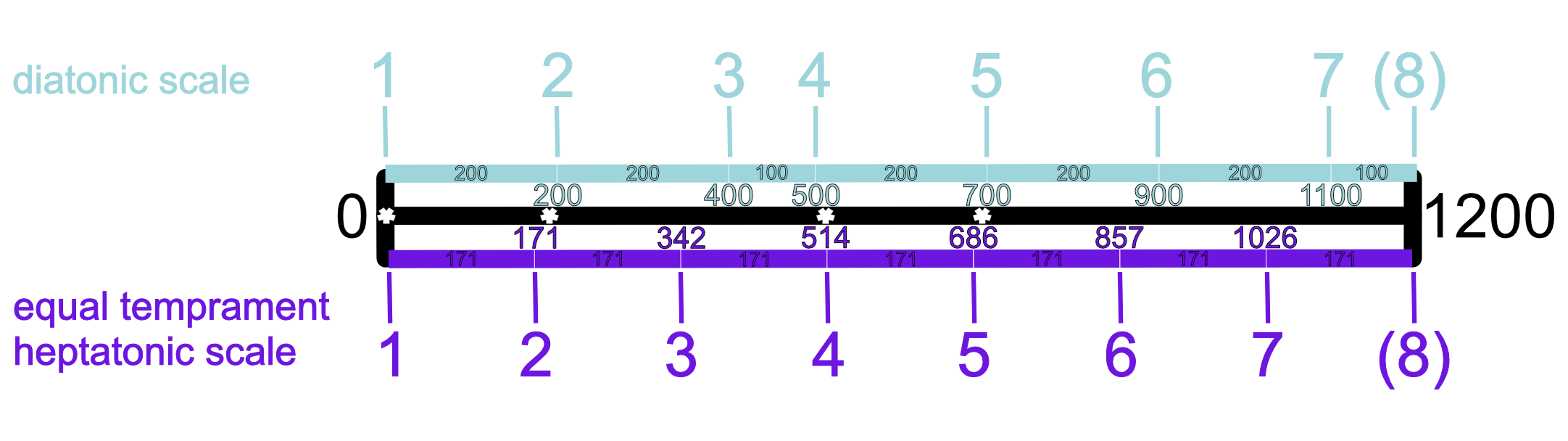
Bo Diddley doesn’t need a slide to bend notes, but man does he bend them.
Around 0:58 of this video when Bo Diddley was on the Ed Sullivan Show in 1955, you can hear the bending note and the distortion really well.
Musicologist Gerhard Kubik points out that this is a shift in “harmony between f and g (relative pitches),” which after studying music made by many different African people, “sounds as if it had been played on a ben mouth-resonated music bow in a bait cult meeting in Gabon,” even though Bo Diddley probably never heard a recording of a bow like that.4 He isn’t sure why Bo Diddley used that kind of shift when “other blues performers of the time did not,” but then doesn’t go into what instrument might be the culprit: the diddley-bow, from which Bo Diddley got his stage name.
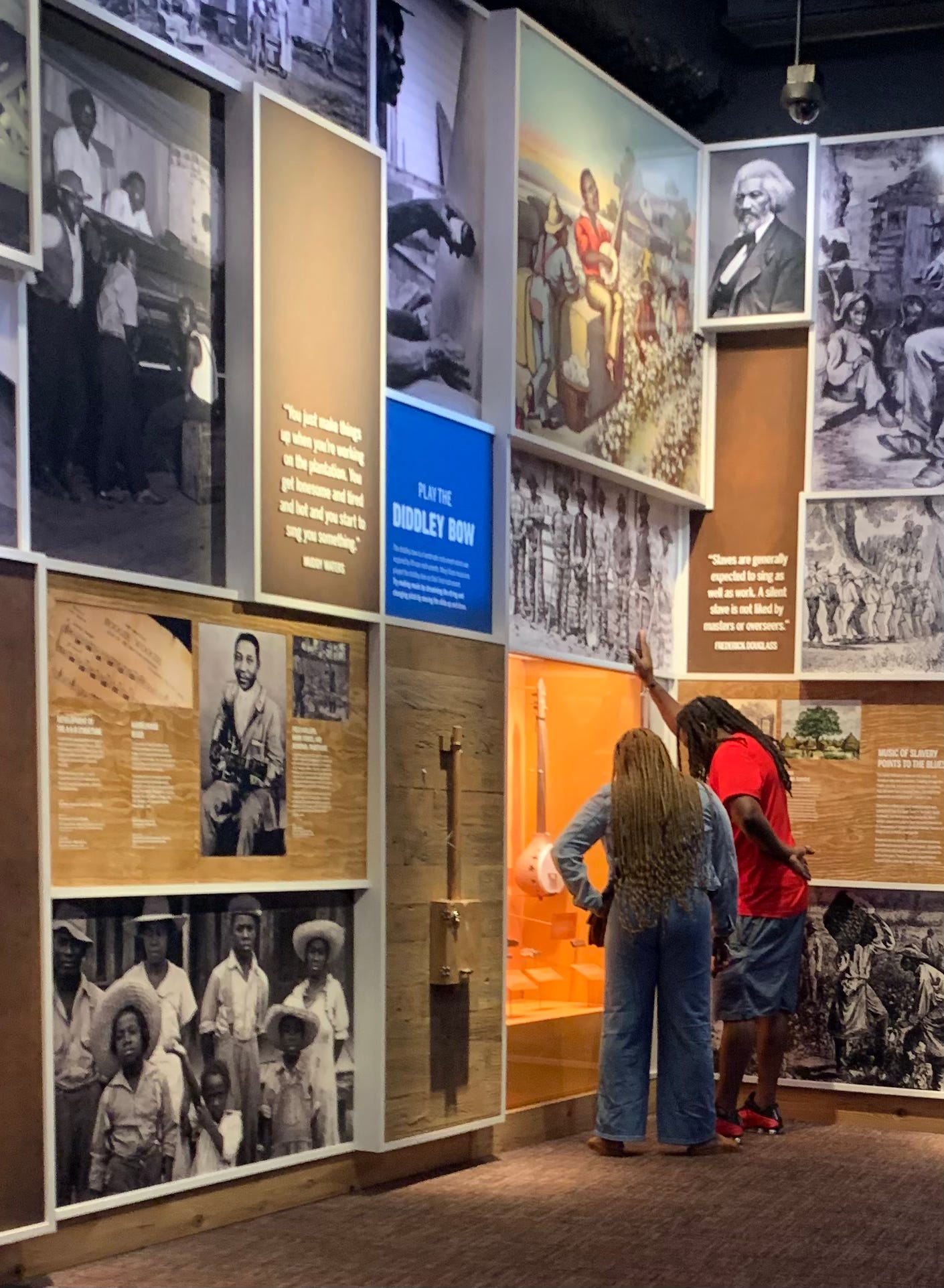
The diddley-bow is an instrument that is made up of a wire tied between two nails, played by plucking the string while moving a glass bottle along it. Perhaps unbeknownst to Kubik, there were also mouth bows being played in the United States, not just Gabon.
Distortion: Laurent Dubois talks about how he thinks the early banjo had a buzz that was similar to the sound that African stringed instruments had by way of a skin head, gourd resonator, and sometimes added metal. It is hard to get an electric guitar to resonate by itself. It has no resonator—it is just a block of wood and a pickup. What you can do is mess with the amp, speaker, and signal. No one seems to agree how he got his fuzz (the magic of Bo Diddley, if you will), but in his 1955 recording of “Bo Diddley,” he was adding a warble to his tone with the DeArmond Tremolo Control, “the first stand-alone guitar effect,” which modulates the volume of the guitar.
Washburne, Christopher. “The Clave of Jazz: A Caribbean Contribution to Rhythmic Foundation of African-American Music.” Black Music Research Journal, Spring, 1997. Vol. 17, No. 1 (Spring, 1997): 59-80.
Floyd, Samuel A. “Black Music in the Cirum-Caribbean.” American Music, Vol. 17, No. 1 (Spring, 1999), pp. 1-38.
Let’s start at the very beginning. A very good place to start. When you read you begin with ABC, when you sing you begin with do-re-mi.
Kubik, Gerhard. “The African Matrix in Jazz Harmonic Practices.” Black Music Research Journal, Vol. 25, No. 1/2 (Spring - Fall, 2005), pp. 167-222.
 | A guest post by
|