
What is in tune?
A digression on scales and transcription (part 1)

This is going to sound obvious, but I’m going to say it anyway: one thing my PhD program (in music) is allowing me to do is to think a lot more about how we try to notate sounds on paper to be able to preserve them or play them again. It wasn’t that I didn’t think about written music before, but I’m really enjoying doing technical musical comparisons of pieces of music that are supposedly from the Caribbean. In Go Back and Fetch It, Rhiannon and I wrote that putting all of those pieces of music together might invite comparisons of tunings, scales, time signatures, rhythmic patterns, etc., and now I find myself doing some of that work.
But, this puts me in a bind. I have always wanted to communicate to a broad audience— it is why I focused on public history at UMBC for my undergraduate and then did an MFA in nonfiction writing— but written music creates a barrier for many people. The reason that Go Back and Fetch It came about in the first place was because all of the musical examples in Well of Souls got nixed by my editor, who said the average reader wouldn’t read music, and these illustrations would be lost on them. She’s not wrong (if you don’t read music it might as well be a foreign language), but I knew these examples were important. Luckily, Rhiannon thought so, too, and suggested we put them and others into a book.
I’ve been thinking about the different ways that musical cultures make scales, or the notes in a specific piece of music. But if someone can’t read music,1 how do I explain these scales to people?
To start with, you should know an amazing fact about hearing an octave, or the beginning and ending of scale. If you take any string and tighten it between two points, you pluck it and get a note. If you put your finger halfway between those two points, you will get the same note, just at a pitch is an octave above that first tone. Cultures all over the world choose to sing or play notes between those two tones, resulting in scales.
[Sidebar: For the sake of everyone having a common understand, musicologists have decided that an octave is made up of 1200 cents. What is a cent? That is not in today’s lesson.]
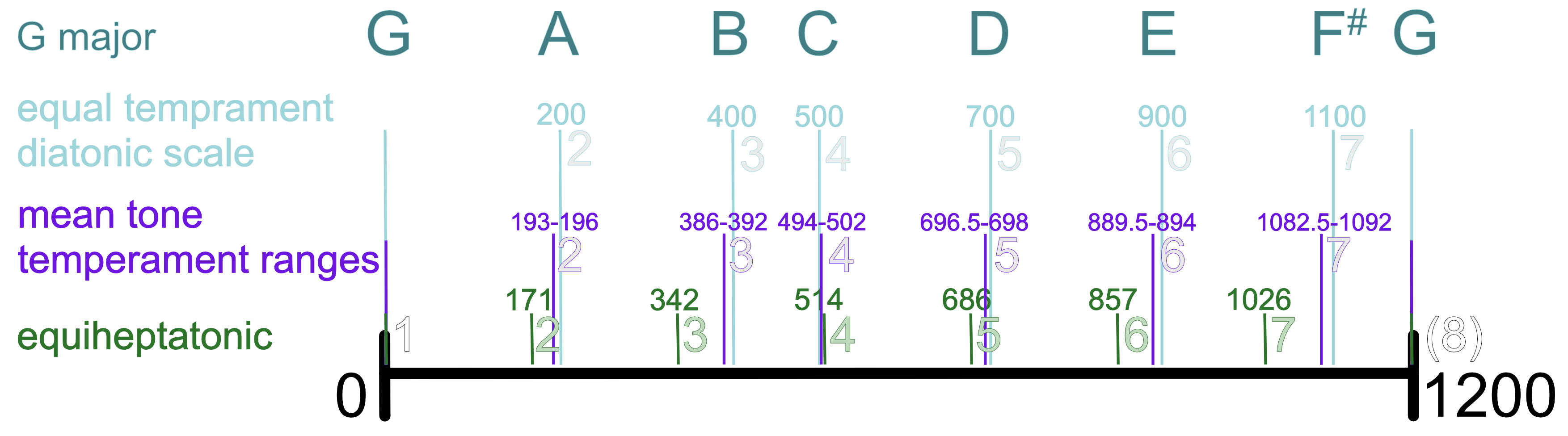
What many people refer to as a major scale—and sung as do, re, mi, fa, sol, la, ti, do— and has been standardized by Western Europeans as the equal temperament diatonic scale (equal spaces between each half step as 100 cents, with seven notes—see the diagram below for spacing)
How this sounds is best illustrated by Maria in The Sound of Music:
Before this scale was standardized, even in Western European there were lots of different scales with slightly different pitches (called mean tone scales). This is why if you played a harpsicord tuned to how it might have been in 1760, it would sound “off” or out of tune to our ears, because we’ve gotten used to the sound of a modern piano and the standardized pitches (mostly adopted in the 20th century).
The idea of what is a right note and a wrong note is entirely cultural, and one ethnomusicologist suggests that you develop this notion of what pitches are right or wrong as a child. You can learn the others, but like a first language, one way or hearing will always be your standard.
After reading Melvin Gibbs’s How Black Music Took Over The World, I was particularly curious about how the equiheptatonic scale used by some African cultures sounded. Like the major or minor scale, it has seven (hepta) tones (tonic), but they are divided up equally across the octave (equi). This means they won’t line up with the major or minor scales.
In comparison to a major scale, it starts and ends at the same place, and the second, fourth, and fifth scale degrees are pretty close, but the third and the sixth are a little off, while the seven is really off.
To visualize all of that, I created this:
But this is all still so technical that I don’t want to write it at all!
Your eyes are glazing over!!
I took a workshop on data visualization for PhDs here at the university, and when I showed this to the self-admitted non-musical instructor (who is a photographer), I saw how flawed the diagram was if you didn’t have some musical knowledge. Sure, you can see the difference, but you can’t hear it, and isn’t that what is important in music? How “out of tune” will this scale actually sound?
So with the skills I learned in the workshop, I made this.
Also, I should note this only works because I did it on my fretless banjo! This wouldn’t work on a fretted guitar (I just left the markers in for reference) because the frets are set at those pitches 100 cents apart!
How does it sound? Does the equiheptatonic just sound “out of tune” or does it sound different to you?
I also got curious about how the scale played by West African fiddlers as documented by Jaqueline Cogdell Djedje fits into this. Djedje writes that it is a pentatonic scale (5 tones across the octave) and starting on a G it would be G-A-C-D-F-G (or the 1-2-4-5-flat 7-8). Getting even more technical, you might call this the mixolydian (which has that lowered 7th scale degree) without the 3 or 6; but it also really close to the equiheptatonic without the 3 or 6. Ah! Too technical again!!
Here’s what that sounds like.
That’s also not the minor pentatonic scale that often gets referenced as being part of African American music.
I’m also thinking about how European observers might have tried to capture different scales, especially those played by musicians in Africa and ones transferred to music played by people of African descent in the Americas? A keyboard or fretted instrument only has the notes of the twelve-tone scale. You can’t play anything that is just a little off like you can (and beginners do) on a violin or fretless instrument. If you’re writing music down, you have to try to capture this in-betweenness or “out of tune” sound somehow. Now, after thinking about these scales, when I look at certain transcriptions, I’m starting to see the in-betweenness, the bending of notes, come through even on pieces I’ve been familiar with (which I’ll share soon).
Also, let me know if this was still too technical in the comments below!
Also, here are some things coming up!
On July 1 at 6pm, I’ll be at the Library of Virginia to play some music (with Pete!) and talk about musical culture in Virginia c. 1776. Find out more here.
On July 22, save the date for the Black Banjo Symposium at the Library of Congress, a full day of banjo talk, free and open to the public.
I am also teaching a class on writing structure for Narratively in July. It is in three parts, and we will talk all things nonfiction writing structure, which I love to nerd out about. You can learn more here.
I can’t see a piece of music and sing it perfectly. I can feel the general outlines of a melody in treble clef and if I have my instrument, I can play it.
 | A guest post by
|
Not too technical at all. The "visualization" - both aural and optical - tool is excellent. Thank you.
I love this specific exploration into the cultural crack notes, modes, and scales. All of this discussion definitely falls into the spectrum of Intangible Cultural Heritage of Humanity beyond the metrics of microtonality.
I greatly appreciate your riffing.
I might see y'all in Richmond at the Library gig, we now live in Charlottesville, but we're heading to NYC early the following day.
Kram & cheers